
How do Fortune 50 companies disclose political risk in SEC filings and earning calls?
We analyzed how the biggest US companies discuss political risk in their filings. NVIDIA shows us how companies are reframing political risk as potential upside.


This post is a guest post by Leo Gerza and Alexander Ting, two of our research interns at Unruly – all credit to them.
Geopolitics bedevils corporate decision-making. Whether it’s long-standing trade tensions with China, the weaponization of tariffs, or the spontaneous reshaping of the geopolitical map through force, corporations are faced with an evolving list of risks to manage. Today these risks have moved from peripheral to squarely material, so we wanted to understand how companies are talking about them – particularly when they are legally obliged to disclose and tell the truth. Since we can’t access their private strategy meetings, we turn to their filings and earnings transcripts as a proxy.
Our colleague Alexander created a tool to ingest and analyze the last five years of earnings call transcripts and SEC filings from Fortune 50 companies. Then, an using our Unruly AI toolkit we gave each document a salience score from 1 (boilerplate risk disclosure) to 5 (all about geopolitics). Salience measures how explicitly management named and quantified specific policies, regimes, and cross-border events. We then used these salience scores to look for patterns and interesting outliers. It’s probably no surprise that managed care ranked the lowest while energy and information technology were the highest.
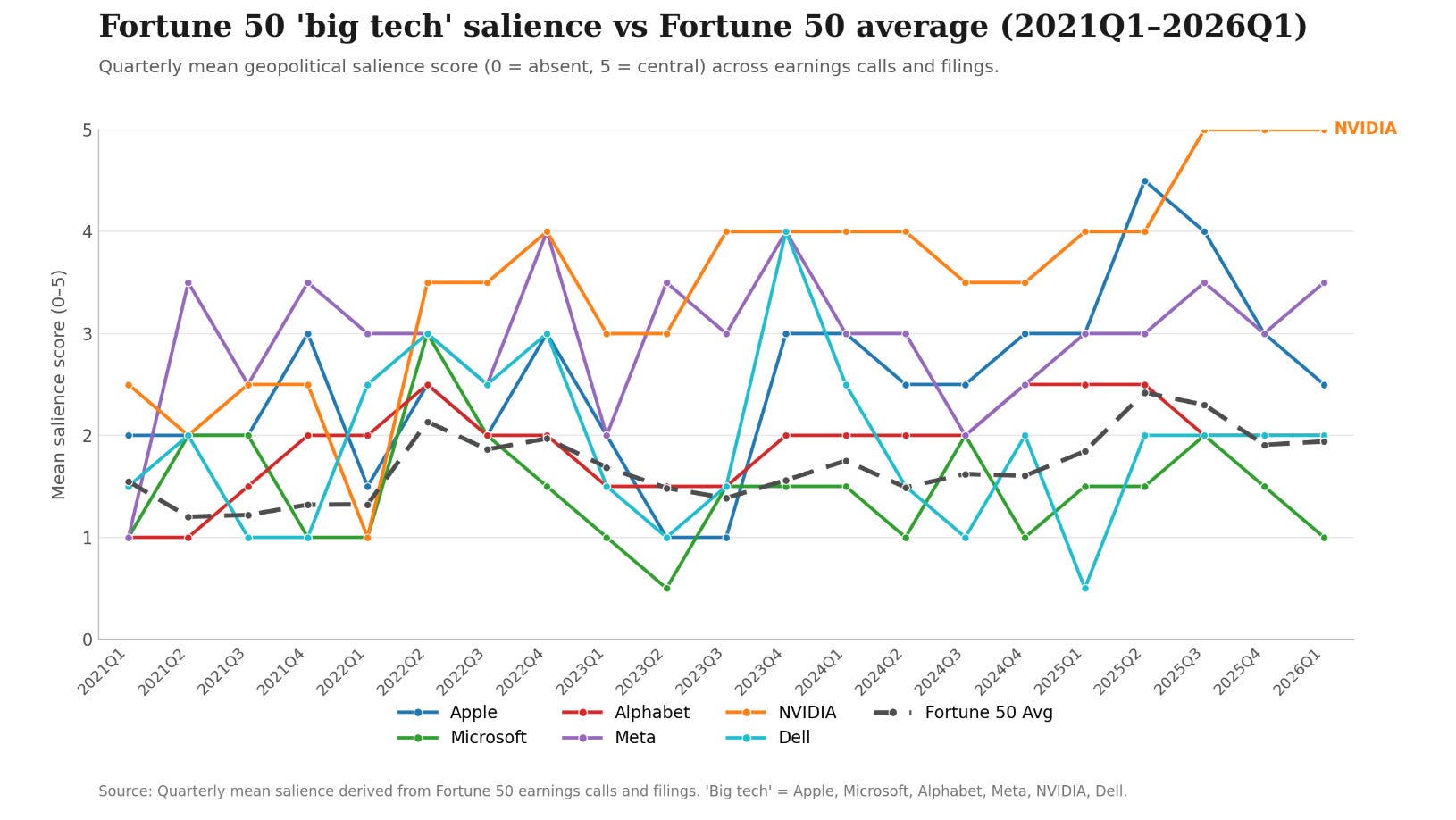
Across the dataset, while several Fortune 50 companies scored highly on salience, NVIDIA stood apart in that its salience remained almost consistently rising with only two downward swings after 2Q2022. Digging deeper, we found that while export control to China was the catalyst in raising its geopolitical salience score, beginning in Q4 2023, NVIDIA executed a deliberate narrative strategy to leverage the concept of “sovereign AI” as an explicit way to reframe its geopolitical exposure as a commercial opportunity. Sovereign AI refers to the idea that governments should develop domestic AI capabilities, including compute infrastructure, data systems, and models, as a concern of national economic and strategic autonomy (NVIDIA Blogs).
NVIDIA’s recent disclosures show how companies can turn geopolitical exposure into a narrative about geopolitical opportunity. Between Q2 2020 and Q1 2026, the company shifted from acknowledging geopolitical disruptions to making geopolitics central to the story it told to its investors. As U.S. export controls restricted NVIDIA’s data-center business in China, its management reframed the geopolitical environment it found itself in as an opportunity for new demand in sovereign AI.
Notably, other companies sitting at a similar geopolitical intersection defaulted instead to conventional risk management narratives.
The rest of this blog examines how NVIDIA turns China exposure into sovereign AI opportunity, why that story appears most clearly in earnings calls while SEC filings retain the language of legal and compliance risk, and how this makes NVIDIA unusual among the Fortune 50.
NVIDIA vs the Fortune 50
Across the Fortune 50, NVIDIA is an outlier not only because geopolitics appears frequently, but because management makes it central to the company’s growth story.
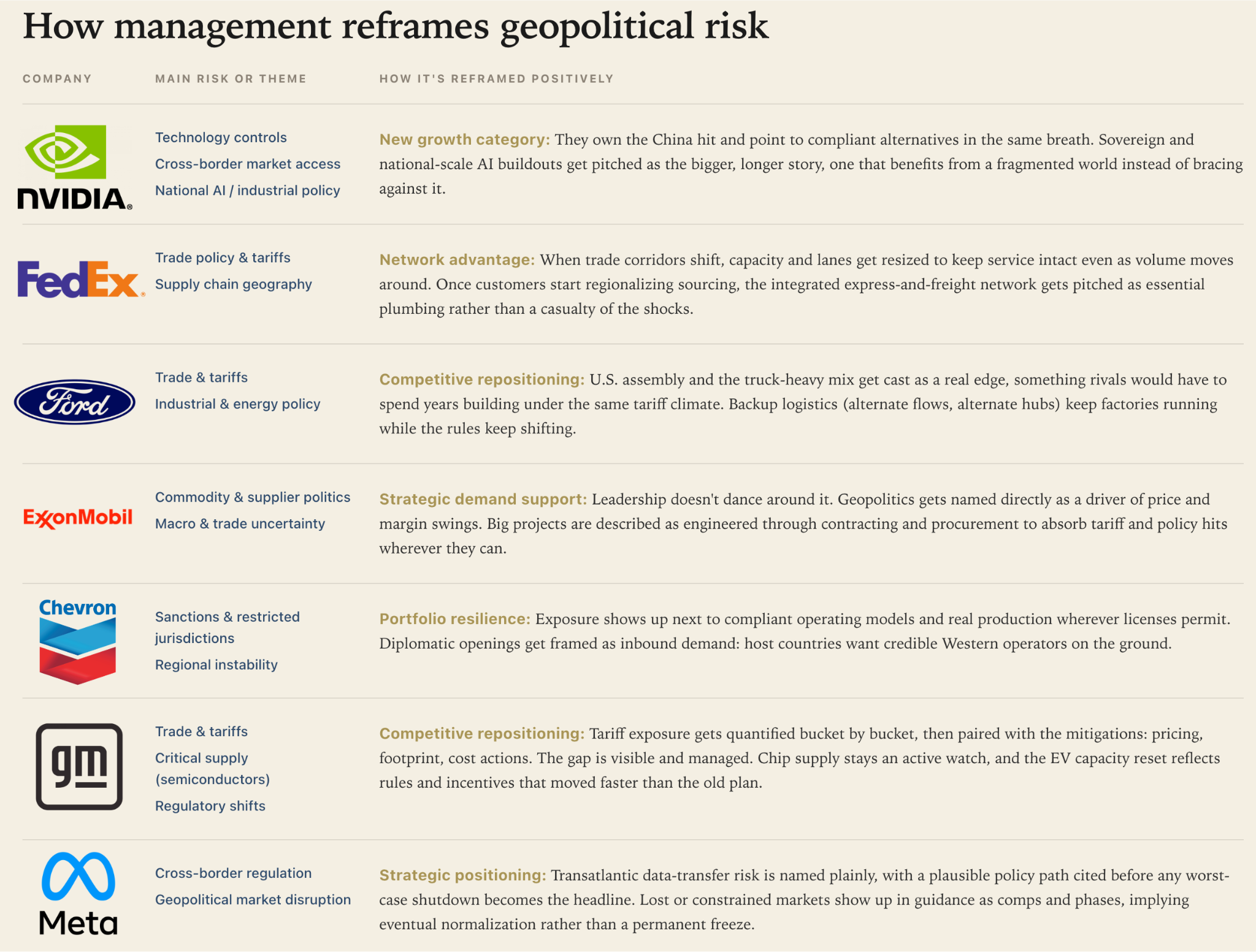
For most companies, geopolitics appears as an external disruption: tariffs, sanctions, war, supply-chain instability, commodity volatility, foreign exchange, or country-specific operating risk. These issues are material, but they are usually framed as shocks to be managed. The company absorbs the disruption, adjusts the supply chain, manages compliance, hedges exposure, or passes through cost.
NVIDIA is also unique among much of the technology sector. Apple, Microsoft, Dell, and others all disclose or discuss geopolitical exposure, but in a more fragmented pattern. Apple’s geopolitics clusters around China manufacturing, EU regulation, App Store rules, and supply-chain adjustment. Microsoft’s clusters around sanctions, cyber risk, public-sector demand, and export restrictions. Dell’s centers more on supply chains, AI servers, and China-related controls.
Other companies also sometimes turn geopolitics into a positive story. GM and Ford frame U.S. industrial policy as support for domestic EV and battery manufacturing. UPS treats nearshoring and the shift of manufacturing closer to the United States as an opportunity for its Mexico and cross-border network. Energy companies make a parallel argument that geopolitical instability increases the value of diversified LNG, upstream production, and reliable supply.
But these are narrower reframes. For GM, Ford, UPS, Exxon, or Chevron, the opportunity usually attaches to a policy, asset, or supply-chain adjustment. NVIDIA’s approach is more concentrated and more ambitious. Its management not only tells investors that geopolitics affects the business, but also actively positions geopolitical fragmentation as an opportunity to expand demand for its services – if export controls restrict one market, then sovereign AI, allied infrastructure build-outs, and national compute strategies attaches it to others with an explicitly geopolitical agenda.
NVIDIA’s Geopolitical Narrative Strategy
NVIDIA entered this decade carrying an unusually concentrated set of geopolitical exposures. Its high-performance GPUs, central to AI training and data-center acceleration, placed the company at the heart of the U.S.-China technology rivalry, which was strategically valuable because its chips enabled frontier AI development, but also strategically vulnerable because that same importance made them a target for export controls.
By late 2023, NVIDIA disclosed that U.S. licensing requirements covered products including A100, A800, H100, H800, L40S and other high-performance chips, and that sales to China and other affected destinations had contributed roughly 20–25% of Data Center revenue over the prior few quarters. Its reliance on Taiwan compounded this exposure as NVIDIA’s supply chain used TSMC to produce semiconductor wafers, and NVIDIA itself warned that tensions involving Taiwan and China could materially affect suppliers, contract manufacturers, and assembly partners critical to supply continuity. By 2023, then, NVIDIA was not simply another multinational exposed to geopolitical noise. It occupied the rare position of being both highly exposed to geopolitical risk and capable of shaping that risk through its own product design, customer choices, supply-chain decisions, and role in the global AI infrastructure build-out.
To understand how management communicated about these geopolitical risks, we used an LLM to label and analyze every NVIDIA earnings call from Q2 2020 through Q2 2025. For each call, we extracted distinct geopolitical event mentions – named policies, countries, regulatory regimes, wars, sanctions, export controls, and cross-border dynamics – and classified them by theme. We also tracked whether the subject was raised by analysts or introduced by management.
Across the first fourteen quarters analysed (Q2 2020 to Q3 2022) NVIDIA’s geopolitical narrative is mostly defensive. Export controls recur throughout the period, Russia-related mentions rise after the February 2022 invasion of Ukraine, and China/Taiwan supply-chain risk becomes more prominent in May and August 2022 as advanced-semiconductor restrictions moved to the center of U.S.-China technology competition. The 2022 BIS restrictions marked the turning point, because once the export of its A100 and H100 chips to China and other restricted destinations required U.S. government licenses, geopolitics became a direct constraint on NVIDIA’s Data Center business.
NVIDIA’s language in this phase is managerial rather than opportunistic. It identifies sales at risk, records inventory charges, warns of disruption to product development and China-based operations, seeks regulatory exemptions, and introduces compliant substitutes such as the A800 chip. Geopolitics, therefore, is presented as a challenge that it is absorbing and finding ways to route around.
Then its earnings call in November 2023 changes the narrative around its geopolitical exposure.
That earnings call contains the highest number of distinct geopolitical event mentions in NVIDIA’s earnings-call record to that point, but the important feature to look at is the topic composition of that call. Earlier geopolitical mentions had mostly clustered around constraints, such as export controls, China/Taiwan risk, and supply-chain exposure. In this call, the focus shifts towards “Sovereign AI”. India, France, Japan, Sweden, Germany, and the UK are named individually, alongside a broader global claim that national investment in computer capacity had become a “new economic imperative” and a “multi-billion dollar opportunity.” NVIDIA was, by then, no longer telling investors where risk was emerging but was pointing them towards where new demand might come from. In other words, NVIDIA recast the same geopolitical fragmentation that was underpinning access restriction to China as the driving force behind U.S.-allied governments elsewhere wanting to build domestic AI infrastructure.
The timing in November 2023 is significant because this was also the same reporting cycle in which NVIDIA had to tell investors that new U.S. export restrictions would hit products previously sold into China and other affected destinations, which had contributed roughly 20–25% of data center revenue over the prior few quarters. What follows is a consolidation of the narrative. Sovereign AI continues to appear in later calls, but the event count normalizes and management shifts from naming countries to sizing the opportunity: first as a multi-billion-dollar market, then as high single-digit billions, then low double-digit billions. The chart captures the launch. The revenue commentary explains what the launch was for.
Proactive vs Reactive
One of the most important learnings in our analysis of Fortune 50 earnings calls was that some companies proactively shape their geopolitical narrative through their SEC disclosures and mentions on calls by their executives while others only engage on the topic when asked about it by analysts. Interestingly, companies overall are growing more proactive, with forward-looking disclosure rates doubling from 12.8% in 2024 to 27.7% in 2025.
The focus on “sovereign AI” in NVIDIA’s earnings calls appears to be initiated by management rather than by analysts. Analysts mainly asked about China restrictions, supply constraints, and near-term revenue exposure. Management, in turn, answered those questions but then widened the frame. Colette Kress, NVIDIA’s CFO translated sovereign AI into a revenue category. Jensen Huang, CEO, then gave it a more ideological and geopolitical texture, arguing that countries increasingly see their data and AI capacity as national resources, and therefore want to build domestic AI infrastructure.
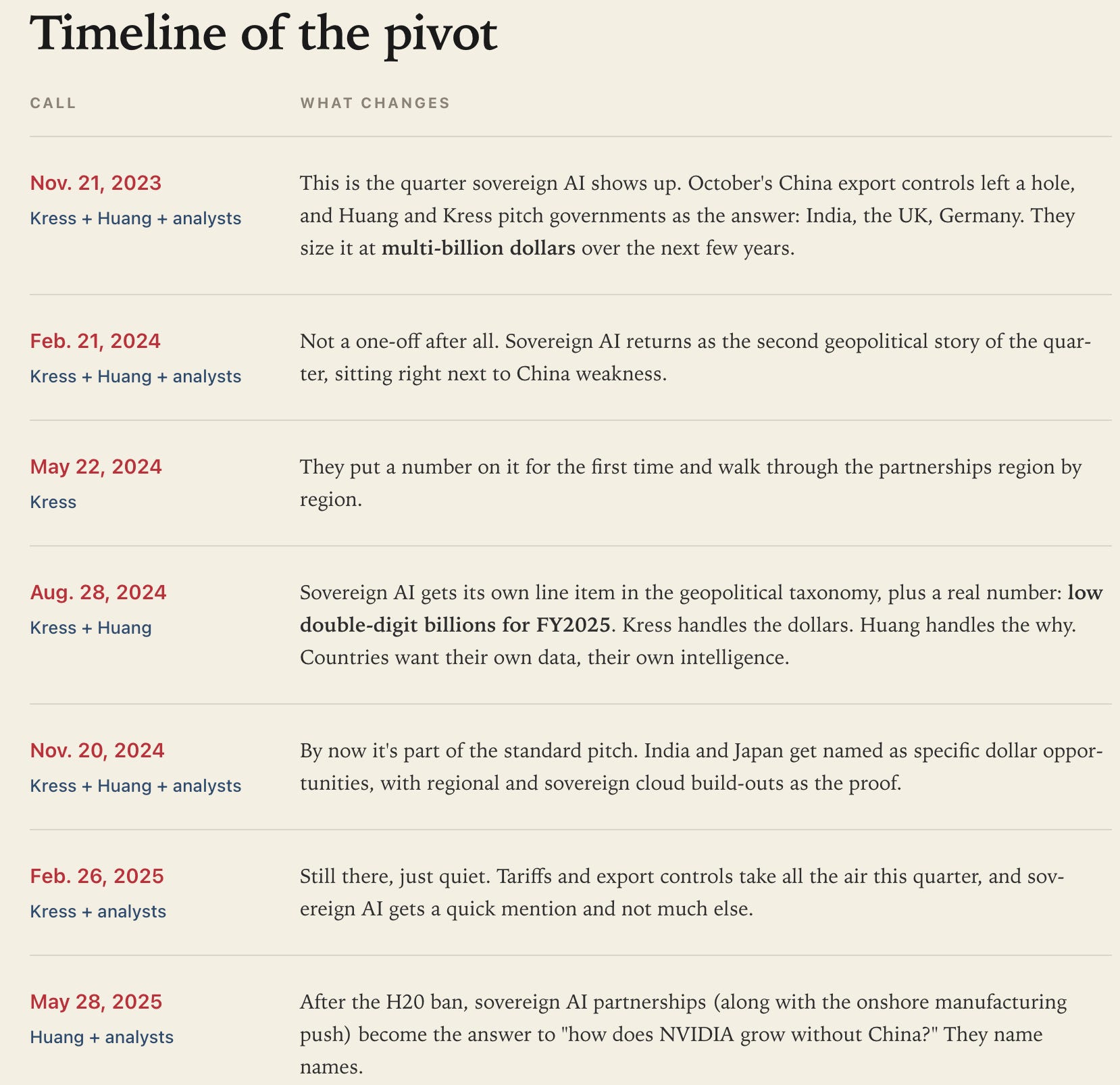
The division of roles within NVIDIA’s management is also important. The timeline shows that sovereign AI first appears as a response to the export-control shock of late 2023, when China risk had become harder to avoid and management needed a credible alternative growth story. On the November 2023 call, Kress and Huang begin that pivot together: Kress frames sovereign AI as a “multi-billion dollar” revenue opportunity, while Huang gives the idea its broader strategic logic by pointing to governments that want to build their own AI infrastructure. That split becomes clearer through 2024. Kress increasingly translates sovereign AI into a measurable revenue category, moving from general opportunity language to claims that it could grow from virtually nothing into billions of dollars in annual revenue. Huang, by contrast, supplies the geopolitical and ideological texture, arguing that countries now see their data as a national resource and want to develop their own “digital intelligence.” The result, perhaps somewhat unsurprisingly, is that Kress takes on the work of articulating “Sovereign AI” as a market, while Huang makes it legible as a theory of national technological power.
National Champions
NVIDIA’s sovereign AI narrative is interesting because it helps square what might otherwise look like a contradiction. On one level, NVIDIA increasingly looks like a U.S. national champion: a company whose chips sit at the center of American AI power, export-control policy, and technological competition with China. At the same time, its sovereign AI strategy is about helping other countries build their own domestic AI capabilities. But those two things are not really at odds, rather they are part of the same strategy.
The point is not that NVIDIA is helping other countries become independent of U.S. technology. It is that NVIDIA is offering them a version of AI sovereignty that still depends on U.S.-designed infrastructure. For governments, this is attractive because it promises national compute capacity, domestic control over data, and a stronger claim to participation in the AI economy. For the U.S., it is attractive because those capabilities are being built through an American company. NVIDIA’s role, then, is not just to sell chips. It is to extend U.S. influence through the infrastructure other countries use to build their own AI systems.
This also explains why the sovereign AI story works so well as a business strategy. If China is increasingly closed off, and NVIDIA now says it has 0% market share there, the company needs a growth story that does not depend on recovering that market. Sovereign AI provides one. Instead of a world divided between the U.S. and China, NVIDIA presents a world of many national AI markets, each with its own demand for compute, data infrastructure, and model-building capacity. Geopolitical fragmentation, in this telling, does not only close off one market. It creates the logic for building many others.
That does not mean NVIDIA escapes geopolitical risk. Export controls still bite. China still matters because Taiwan remains a major structural vulnerability. But completely escaping risk can never really be the end goal. The point is to be better positioned when those risks inevitably arise. NVIDIA’s achievement is that it has stopped geopolitics from being only a story about constraint. Instead, it has made geopolitical exposure part of the reason the company matters.
That is why the national champion frame is useful here. As Sean West argued in GeoLegal Notes in March 2025, companies under political pressure increasingly need to make their case in the language of both economic logic and patriotism. NVIDIA’s sovereign AI narrative does exactly that. Governments get a story about national capability. Investors get a story about durable demand. Washington gets a story about allied technology leadership. NVIDIA gets a way to turn the same geopolitical fragmentation that threatens one market into the rationale for building many others. In an unruly geopolitical environment, the companies best positioned will not simply be those that manage risk well. They will be those that can explain why their growth also serves the strategic priorities of states.
About the Authors
Leo is an intern at Unruly and a History and Political Science Major on the Columbia – Sciences Po Dual BA. Alex is an intern at Unruly, where he works on applied AI tools and research, and a junior in high school planning to major in data science.
 | A guest post by
|
 |
|
This is very good. The product that traders need is a distillation of this for every equity that they can use in their work flow. I am working on that at GeoBull GeoBear