
Seeing ALL implications of the Iran war within hours of the first missiles
…and reminding ourselves that AI is about speed, not cost reduction


As the first bombs started landing in Tehran in late February, geopolitical research houses sharpened their pencils to figure out their views. Most tried to jump immediately to the “answer” - namely predicting how long hostilities would last - and crafting a few representative scenarios about how war could play out.
Yet, in the hours following the first bombs, most companies were focused on what it actually meant to their businesses today. Companies have sprawling global supply chains. They have employees sitting in the Emirates airport lounge. They are enmeshed in the middle of churning bilateral relationships. Whether the war ends sooner or later, they needed to figure out their existing exposure. Quickly.
Companies without a dedicated geopolitical risk budget turned to Google News, GPT, or maybe an Economist or FT subscription to get a sense of ramifications. These are affordable, but not able to provide true insights related to their specific business.
Companies with larger budgets turned to a growing number of boutique geopolitical risk research firms. While these firms produce high quality analytical research, it is delivered slowly and rarely iterates at the speed of business decisions or events unfolding. While custom insights can be had with expert phone calls, those insights are out of date with the next headline.
Could AI, instead, give these companies swift, dynamic insights?
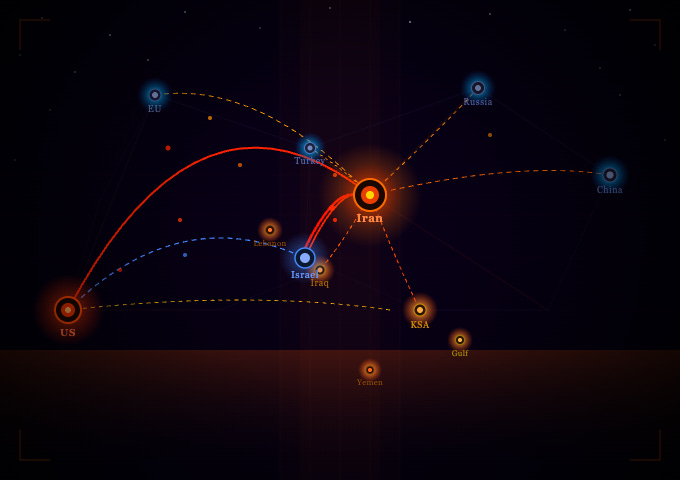
Understanding a war - quickly and dynamically
It is into this space that Unruly Corp’s Global Impact of the Iran Conflict Report fits. We have spent a number of months building a system that can size up global events from every perspective and write like an analyst would. So, we unleashed our AI agents to draft a 150 page report that analyzed the impact of the Iran conflict on 17 countries, sectors, and themes across different areas like economics, security, and politics, as well as scenarios and specific implications. The report created specific scenarios for each region, sector or theme as well as detailed signposts and implications.
Suddenly, even the most minor implications of the war were visible. While analysts might focus on a spike in oil prices due to closure of the Strait of Hormuz, more than 40% of the world’s seaborne sulphur and urea would also be at risk. This wouldn’t immediately be obvious to a regional analyst, but AI seamlessly highlighted how this would be a catastrophe for agricultural firms and those upstream from them. There are many other examples.
The first turn of the report took less time than a research house would spend in a planning meeting to scope out how to produce a comparable report and cost less in compute than the coffee and donuts for that meeting.
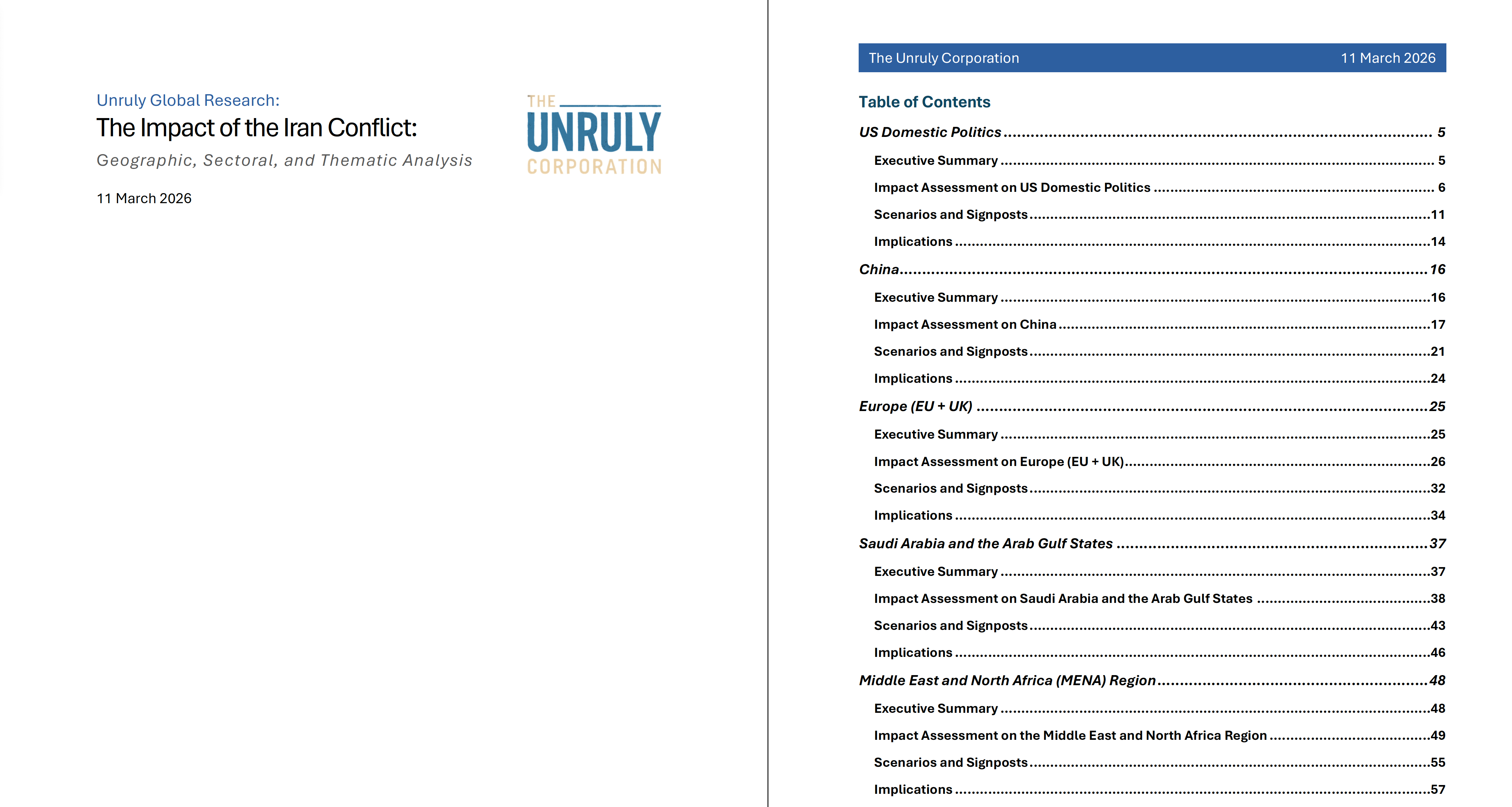
A sample of the TOC for our global Iran report, which you can access at iran.unrulycorp.com
We got quite positive feedback on the report’s breadth, analytical insights, and ability to spin up unique scenarios from a variety of perspectives. Fortune 500 executives liked having everything in a single PDF that was indexed so they could navigate to what they wanted. Others were happy to put the PDF through their own AI agents to digest implications for themselves.
However, we also got answers like:
“There is zero chance I can read a PDF of 150 pages when the world is at war! 😆”
So the following week we created (and expanded) the report while also deploying it as an app for easy consumption. We added entity linking (i.e. searching for a mentioned company or group) to let people get directly to the insights they need. We made the app free to try to help those making sense of the war; you can access in full here here.
The research was an analysis not of the actual conflict itself–there is plenty of high quality daily reporting on that–but rather on the widespread global impact of the conflict that much analysis doesn’t have the bandwidth or time to cover. Perhaps there is coverage of the impact on energy markets and major countries like India, China, the Gulf states, and Europe, but what about the impact on Latin America or sub-Saharan Africa? Or the defense industry? Or cyber? Perhaps in ad hoc ways, but never holistically.
Full Visibility
Why aren’t there more bespoke reports like this? The answer is largely due to cost and the sheer time it would take human analysts to do it. Whatever the real analytical shortcomings of AI-generated geopolitical analysis, its benefits include not only vastly reduced cost but also unconstrained bandwidth to produce whatever analysis is needed at whatever moment for whatever use case.
If everyone’s money-is-no-object first choice is to commission a team of the world’s greatest geopolitical experts to drop everything and write them a custom report on Iran and its impact on an unlimited array of countries, regions, industries and themes, a really good second choice is to have an AI system produce a report that is nearly as good for a fraction of the cost. And then produce an update to that report the next hour, day or the next week. And then customize it for a particular client’s exposure. And then do it all again for the next global development.
Indeed, the fact that there is very little marginal cost to successive insights allows us to explore angles in the first instance that might not be explored for weeks by human analysts focusing first on where all the money is. For instance, if you are focused on Southeast Asia, you know that the closure of the Strait of Hormuz will cause an energy supply crunch, but are there firms putting out research about the Iran conflict from the perspective of Southeast Asia? Or on the metals and mining industry? Or food prices in East Africa? Or more specifically, all the ways that the crisis is affecting shipping giant Maersk or the implications for cybersecurity firm Crowdstrike?
Such analysis is unlikely to be proactively created and constantly updated by humans because the time and cost involved isn’t worth the narrow demand. AI geopolitical analysis fundamentally changes that equation around what is possible and economical.
Cost+Speed
The obvious savings here is cost, but the far more valuable savings here is time. Cost reduction is always appealing, but given the unruliness of today’s world, cost reduction essentially only reduces cost, whereas speed increases upside opportunity.
Across industries, speed can only be increased to a point: freight can’t go faster than airplanes fly, legislation moves at the pace that it does, and analysts and editors produce analysis at the speed they do.
So, can a human-powered firm provide a report about the full global impact of the Iran conflict for me tomorrow? For most firms there is no price that can make that possible. But leveraging AI-generated analysis not only makes that possible, it then also opens up the possibilities of having those insights faster. The marginal cost of another report about another angle on another issue is obviously quite low; but the ability to fast forward in time to get those insights faster is the thing that will transform how businesses use geopolitical analysis to defend against fast moving risks and create opportunities among chaos.
In a quickly changing world, speed is a force multiplier. Analyses, topics, and insights need to evolve as quickly as events morph and as quickly as business opportunities manifest. Each morning a business leader can now have an in-depth report on the global implications of the Iran war on key geographic locations and industries of critical interest. But then the real trick is that there could be another updated report that is focused on a different narrow issue and customized for a particular executive by lunch as circumstances change.
Whether done with our software or constructed in a foundational LLM, this opens up a fundamentally new way to integrate geopolitical analysis, more akin to instant market data to make financial decisions than a weekly research push. It allows rigorous analysis to be disseminated quickly and at a low cost, which in turn opens the possibility of interactive streaming of geopolitical insight tuned to particular exposures and opportunities.
Speed also shifts expectations with regards to prediction. Yes, the holy grail of geopolitical analysis is to know what’s coming next, but explaining what happened yesterday is actually pretty hard too. With AI, we’re able to solve the yesterday problem at scale, which allows us to understand more of what’s happening today - thus, we can respond in real-time much better.
While we will keep innovating new and different ways to cover global crises, the real question is how your business will change when fast, flexible geopolitical insight is available through any lens, on any timeline, tuned to your specific exposures. More on that in future posts.
-SW & DB
 | A guest post by
|