
The Fall of Orbán
Unruly's AI generated analysis of the Strategic Implications of Hungary’s Political Earthquake


A political earthquake in Hungary is the perfect opportunity for our Unruly Corp. AI tools to analyze what this means for the EU member state, as well as who the global winners and losers are. We generated this report within hours of the election along with visualizations. The system identified the expected winners and losers of Viktor Orbán’s defeat, but also surfaced less obvious dynamics. It assessed the outcome as negative for China, though as significantly as maybe conventional wisdom would say; and it highlighted that the implications for Italy’s prime minister, Giorgia Meloni, are mixed, as she now emerges as the leading far-right political figure within the EU. Readers may disagree with specific conclusions of the full report below. However, as an exposition, this effort illustrates that properly structured AI systems can produce rigorous, high-quality geopolitical analysis comparable to that of experienced practitioners.
Executive Summary
Viktor Orbán’s 16-year reign ended on 12 April 2026 in a landslide. With 95.9% of list votes counted, Péter Magyar’s Tisza party leads with 53.7% against Fidesz-KDNP’s 37.8% (Europe Elects). Seat projections based on 90.9% of votes counted show Tisza on track for approximately 138 of 199 parliamentary seats — a two-thirds supermajority — while Fidesz-KDNP is projected at roughly 54 seats (Europe Elects; TVP World). Turnout reached 77.8% by 6:30 PM — before polls even closed — surpassing the previous all-time record of 70.5% set in 2002 (Unruly / AFP). Orbán conceded, calling the result “painful but unambiguous” (Unruly / AFP).
The core judgment: This is not a clean democratic restoration. It is the beginning of a protracted institutional reckoning in which a former Fidesz insider — socialised in the very system he promises to dismantle — will attempt to reverse 16 years of state capture using tools that Orbán deliberately booby-trapped before leaving office (Politico). The supermajority, if confirmed in final results, is the single most important variable: it gives Magyar the constitutional authority to rewrite the rules Orbán embedded in cardinal laws. The threshold is 133 seats (Bloomberg). Current projections of 138 seats suggest Tisza will clear it, but final results — including individual constituency races — are not expected until later this week.
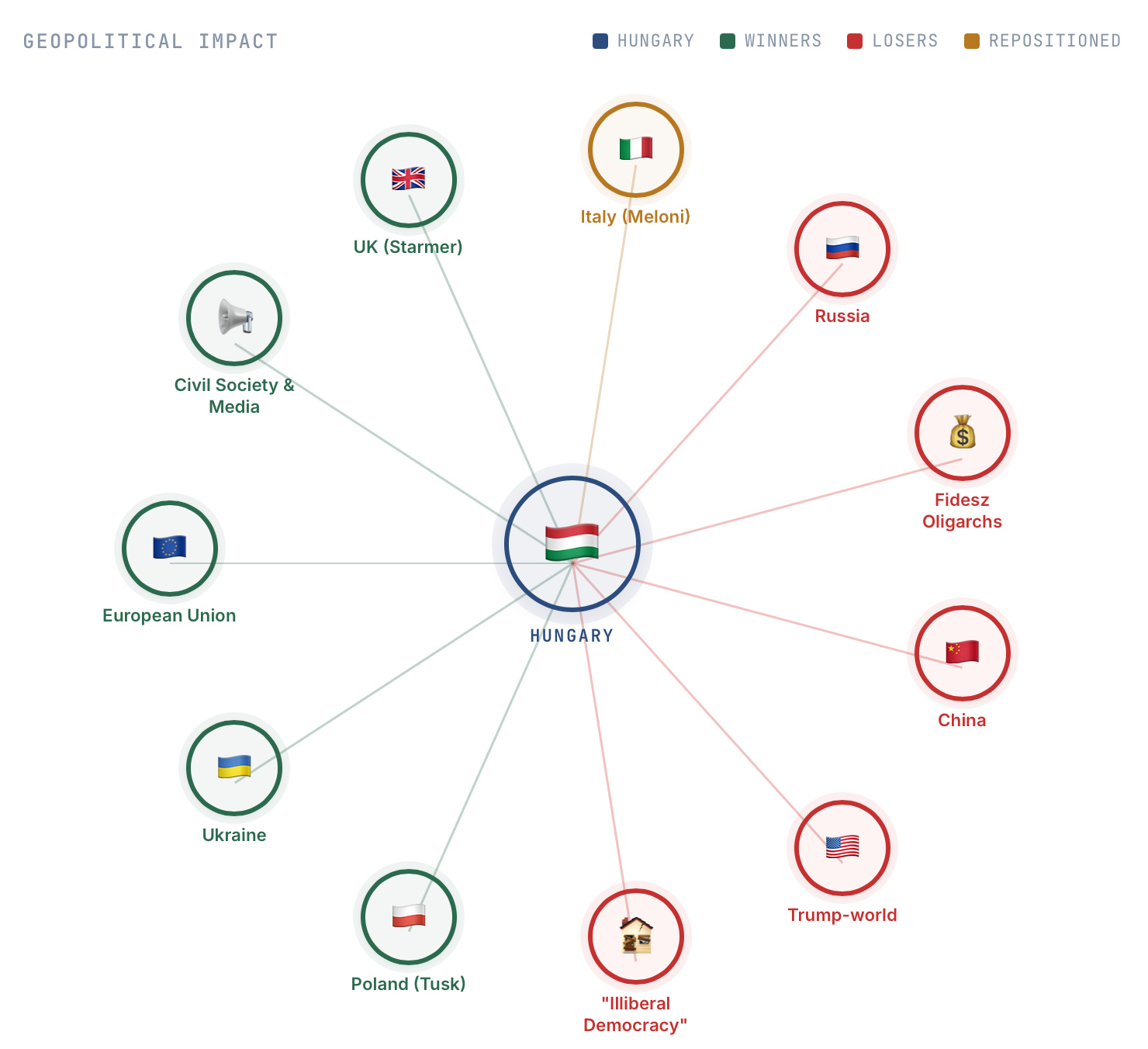
Biggest geopolitical winners: The European Union, Ukraine, NATO cohesion, and Hungarian civil society. Biggest losers: Russia’s leverage in the EU Council, China’s privileged access to Central Europe, and the transnational illiberal-populist network that treated Budapest as its ideological capital. The defeat also lands as a symbolic blow to Trump-world at a moment when the White House invested direct political capital — JD Vance rallied with Orbán in Budapest five days before the vote (BBC) — and lost.
What Happened and Why It Matters
Orbán lost because corruption became visible enough to override culture-war politics. The battery-plant environmental scandal — involving Chinese and South Korean factories accused of toxic discharges with government complicity — crystallised public anger over a regime that had become more interested in enriching its network than delivering services (Reuters; Le Monde). Healthcare deterioration, economic stagnation, and the 2024 presidential pardon scandal involving a child abuser’s accomplice created the opening (Unruly / AFP). Magyar, a former government insider who knew where the bodies were buried, filled it.
The result is historically significant for three reasons. First, it is the most decisive defeat of an entrenched illiberal leader through the ballot box in 21st-century Europe — Hungarians turned out in record numbers to end Orbán’s rule (AP News). Second, it occurred despite an electoral system Orbán had gerrymandered over four election cycles, which analysts estimated could have allowed Fidesz to retain a majority even while losing the popular vote by three or four percentage points (Unruly / AFP; New York Times). Third, it happened after the sitting US Vice President flew to Budapest to campaign for the incumbent — and the electorate rejected the intervention (Salon).
Magyar declared the election win had “liberated Hungary,” telling cheering supporters in Budapest: “Together, we brought down the Orbán regime” (Unruly / AFP). Orbán, for his part, stated: “The election results, though not yet final, are clear and understandable; for us, they are painful but unambiguous. We have not been entrusted with the responsibility and opportunity to govern. I congratulated the winning party” (Unruly / AFP).
What remains uncertain: the final seat count (official results expected later this week), whether Tisza secures the full two-thirds needed to amend the constitution (133 seats; current projections suggest 138), and how quickly Magyar can form a government given the institutional traps Orbán has laid.
Is China a Loser?
Yes — but not catastrophically, and not yet irreversibly.
Orbán was Beijing’s most reliable partner inside the EU. Hungary served as China’s gateway for EV battery supply chains — CATL’s €7.3bn plant in Debrecen being the centrepiece (Reuters) — along with BYD’s approximately €4bn factory in Szeged, which has already begun trial production (Reuters), the aborted Fudan University campus in Budapest, and Huawei’s logistics hub. More critically, Orbán reliably blocked or diluted EU consensus positions on China, from Taiwan statements to investment screening (South China Morning Post).
Chinese firms in Hungary now face a “post-election reckoning” regardless of who won, as the South China Morning Post reported (SCMP). Magyar has signalled a rebalancing, not a rupture. He is unlikely to tear up existing investment contracts — the battery factories employ thousands and represent billions in sunk costs. But the political environment will shift materially:
EU veto cover disappears. Hungary will no longer reflexively shield Beijing in Council votes on trade defence, investment screening, or diplomatic statements. This is the single largest loss for China.
Regulatory scrutiny increases. The battery-plant scandal was a campaign issue. Revelations about foreign battery makers ignoring safety and environmental regulations — and the government helping cover it up — were a major headache for Fidesz (Balkan Insight; Green European Journal). A Magyar government will face domestic pressure to enforce standards that Orbán waived as sweeteners for Chinese investors.
Fudan and telecom access face review. The Fudan campus project, already politically toxic, is likely dead. Huawei’s position will face new scrutiny aligned with broader EU security concerns.
Supply chain positioning survives — for now. Chinese firms already operational in Hungary will adapt. Beijing’s commercial footprint is too large to unwind quickly, and Magyar needs the jobs and tax revenue. CATL’s Debrecen plant alone is expected to create around 9,000 jobs (Bloomberg).
Net assessment: China is a significant loser on diplomatic leverage and EU veto politics, a partial loser on investment access and regulatory environment, but retains its commercial footprint in the medium term. The real question is whether a Magyar government aligns Hungary with the EU’s emerging “de-risking” consensus on China — which would represent a structural, not merely tactical, shift.
What Orbán’s Defeat Means for Trump and the Global Right
The defeat is a genuine blow, and the White House made it worse by going all-in. JD Vance’s Budapest rally on 7 April — where he attacked “disgraceful” European Union interference in Hungary’s election (Reuters) and Trump promised to bring US “economic might” to Hungary if Fidesz won (Unruly / AFP) — turned the election into a referendum on American interference. Hungarian voters answered clearly. As Fox News reported, Hungarians turned out in record numbers despite Orbán being “a strong ally of Donald Trump and JD Vance” (Fox News).
Three implications for Trump-world:
First, the symbolic loss is real. Orbán was not merely an ally; he was the proof of concept — the leader who demonstrated that illiberal democracy could be built inside the EU, sustained through multiple elections, and exported as a model. CPAC Budapest, an overseas version of the most prominent right-wing political event in the US, was the movement’s ideological showcase (euronews). That showcase is now shuttered. As Newsweek asked: “Can MAGA Go Global If It Can’t Hold Hungary?” (Newsweek). Rahm Emanuel argued this marks “three straight losses for Trump-style politics in Europe: Slovenia, French local elections, and now Hungary” (Rahm Emanuel on X) — though this framing overstates the case. In Slovenia, the liberal incumbent beat Trump-allied Janez Janša by barely 1% in the closest election in the country’s history (Bloomberg), and in France’s municipal elections, the far-right National Rally fell short of key targets in Marseille, Toulon, and Nîmes but still made unprecedented gains (Le Monde). Hungary is the only unambiguous rout.
Second, the mechanism of defeat matters. Orbán did not lose on culture-war terrain. He lost because voters prioritised corruption, healthcare, cost of living, and institutional rot over migration fear and anti-woke messaging. As sociologist Andrea Szabo of ELTE University told AFP: “Fidesz decided to run a purely negative campaign... What they talked about was war, war, war” (Unruly / AFP). This is the vulnerability that Trump-aligned movements globally prefer not to discuss: culture wars work until the state visibly fails to deliver basic services.
Third, the exportable parts of the Orbán model survive. The playbook — media capture, judicial packing, electoral gerrymandering, oligarchic patronage networks — has already been studied and partially adopted by actors from Serbia to the US. Orbán’s shrewd tweaking of his country’s political system over 16 years created a model that “illiberal political leaders look up to... as a role model, who has made it, managed to take power,” as Emilia Palonen of the University of Helsinki told AFP (Unruly / AFP). The defeat of the practitioner does not erase the practice.


How Hard Will It Be to Fix the Institutions Orbán Remade?
This is the hardest question, and the answer is: harder than the celebratory mood in Brussels suggests. Orbán spent 16 years embedding loyalists, rewriting laws, and — as Politico documented in detail — laying deliberate “traps” for his successor. He appointed supporters to key state institutions to block budgets and laws (Politico). In December 2025, Hungary’s Fidesz-dominated parliament even passed a bill making it harder to unseat the head of state (DW).
Constitution & cardinal laws
Medium (if supermajority holds) / Extreme (if it doesn’t) difficulty to reverse
Orbán’s 2011 Fundamental Law and dozens of cardinal laws (requiring two-thirds to amend) locked in everything from the structure of the judiciary to media regulation. Armed with a two-thirds majority in 2010, Orbán “implemented a root-and-branch reform of Hungarian state institutions and introduced a new constitution steeped in conservative values” (Unruly / AFP). A supermajority (133 of 199 seats) is the skeleton key. Without it, Magyar governs inside Orbán’s constitutional cage.
Judiciary & Constitutional Court
High difficulty to reverse
Orbán packed the Constitutional Court with loyalists, including a former Fidesz defence minister (Politico). Judges serve long terms. Even with a supermajority, replacing sitting judges raises rule-of-law concerns that Brussels will scrutinise. Magyar has said courts must decide Orbán’s fate and that his government would focus on restoring judicial independence (TVP World).
Media ecosystem
Extreme difficulty to reverse
The Central European Press and Media Foundation (KESMA) consolidated over 470 pro-Fidesz outlets into a single entity in 2018, exempted from antitrust review by government decree (MAPMF; New York Times). Reporters Without Borders (RSF) has classified Orbán as a “press freedom predator,” stating he has “nearly wiped out independent journalism” in Hungary (RSF). Ownership is opaque, legally entrenched, and intertwined with oligarchic networks. You cannot legislate an independent media ecosystem into existence.
Procurement & oligarchic capture
High difficulty to reverse
Hungary is ranked the most corrupt country in the EU, together with Bulgaria, according to Transparency International’s 2025 Corruption Perceptions Index (Transparency International Hungary). Billions in EU and state contracts flow through Orbán-linked oligarchs, most notably Lőrinc Mészáros, a childhood friend of Orbán who became Hungary’s richest man (Forbes; Bloomberg). Unwinding these networks requires forensic auditing, legal proceedings, and political will.
President of the Republic
High difficulty to reverse
Hungarian President Tamás Sulyok, who is close to Fidesz and will be in office until 2029, retains the power to call a snap election if the government can’t form (Politico). Parliament also recently reinforced the president’s position legislatively (DW). This is one of Orbán’s most potent institutional traps.
Security services
High difficulty to reverse
Several whistleblowers from police, military and other state authorities came forward during the campaign to publicly accuse Orbán’s government of incompetence and influencing state institutions for political gain (Unruly / AFP). A growing list of Orbán loyalists began defecting before the election as his vulnerability became apparent (New York Times). Reforming these services without destabilising them is a delicate operation.
The European Policy Centre has argued that the EU should agree with a new Hungarian government on a “binding rule-of-law” framework, with institutional reforms phased rather than frontloaded (EPC). This is the right instinct. Magyar has promised to carry out reforms required to unfreeze billions of euros in EU funds earmarked for Hungary (Unruly / AFP), but the Orbán system was designed to survive its creator. As political scientist Attila Gyulai of ELTE University put it: Orbán “acted as a battering ram” so he could be the one who “wears out first” (Unruly / AFP).
6. Global Implications
EU decision-making transforms overnight. Hungary’s veto — wielded by Orbán to block sanctions on Russia, delay Ukraine aid, obstruct rule-of-law mechanisms, and shield China — is gone. European Commission President Ursula von der Leyen declared “Hungary has chosen Europe,” while European Parliament President Roberta Metsola said “Hungary’s place is at the heart of Europe” (Unruly / AFP). One European diplomat had told AFP before the vote, speaking on condition of anonymity: “Most member states would be quite happy to be rid of Orbán. The patience has worn very thin” (Unruly / AFP).
Ukraine gains a neighbour, not an adversary. Magyar has pledged to make Hungary a “reliable NATO ally” and dropped Orbán’s hostile rhetoric toward Kyiv (Unruly / AFP). He still opposes arms transfers and rapid Ukrainian EU accession — continuity that reflects genuine Hungarian public opinion — but Ukrainian President Volodymyr Zelensky congratulated Magyar, writing: “We are ready for meetings and constructive joint work in the interest of both nations, as well as for peace, security and stability in Europe” (Unruly / AFP). Ukrainian Prime Minister Ioulia Svyrydenko added that “the Hungarian people have said a clear and categorical ‘no’ to any attempt to bring their country back into Moscow’s orbit” (Unruly / AFP).
Russia loses its inside man. Orbán was Moscow’s most valuable asset in the EU — not as an agent, but as a veto-wielding disruptor who reliably slowed Western consensus. Leaked recorded phone conversations caused EU-wide alarm about Orbán’s and his foreign minister’s close relations with Moscow during the campaign, with Polish and Irish leaders condemning the links as “sinister” and “repulsive” (Unruly / AFP). The EU’s top diplomat Kaja Kallas was even more scathing, saying “European ministers should work for Europe not for Russia” (Unruly / AFP). Reports also claimed an ongoing covert Russian social media campaign to boost Orbán and weaken the opposition (Unruly / AFP). An Orbán loss was described by France 24 as “the turning point Putin fears” (France 24). Polish Prime Minister Donald Tusk’s victory message — “Ruszkik haza!” (Russians go home!) — captured the mood across Central Europe (Unruly / AFP).
The democratic-backsliding narrative shifts. For a decade, Hungary was Exhibit A in the global story of democratic erosion. The European Parliament had denounced Orbán’s Hungary as a “hybrid regime of electoral autocracy” (BBC). Its reversal — through elections, with record turnout, despite a rigged system — provides a counter-narrative. As Andrea Szabo, a senior research fellow at ELTE University, told AFP before the vote: “This is the last moment in which this process can be halted, and the pendulum can swing back in a democratic direction” (Unruly / AFP).
7. Winners and Losers
Winners
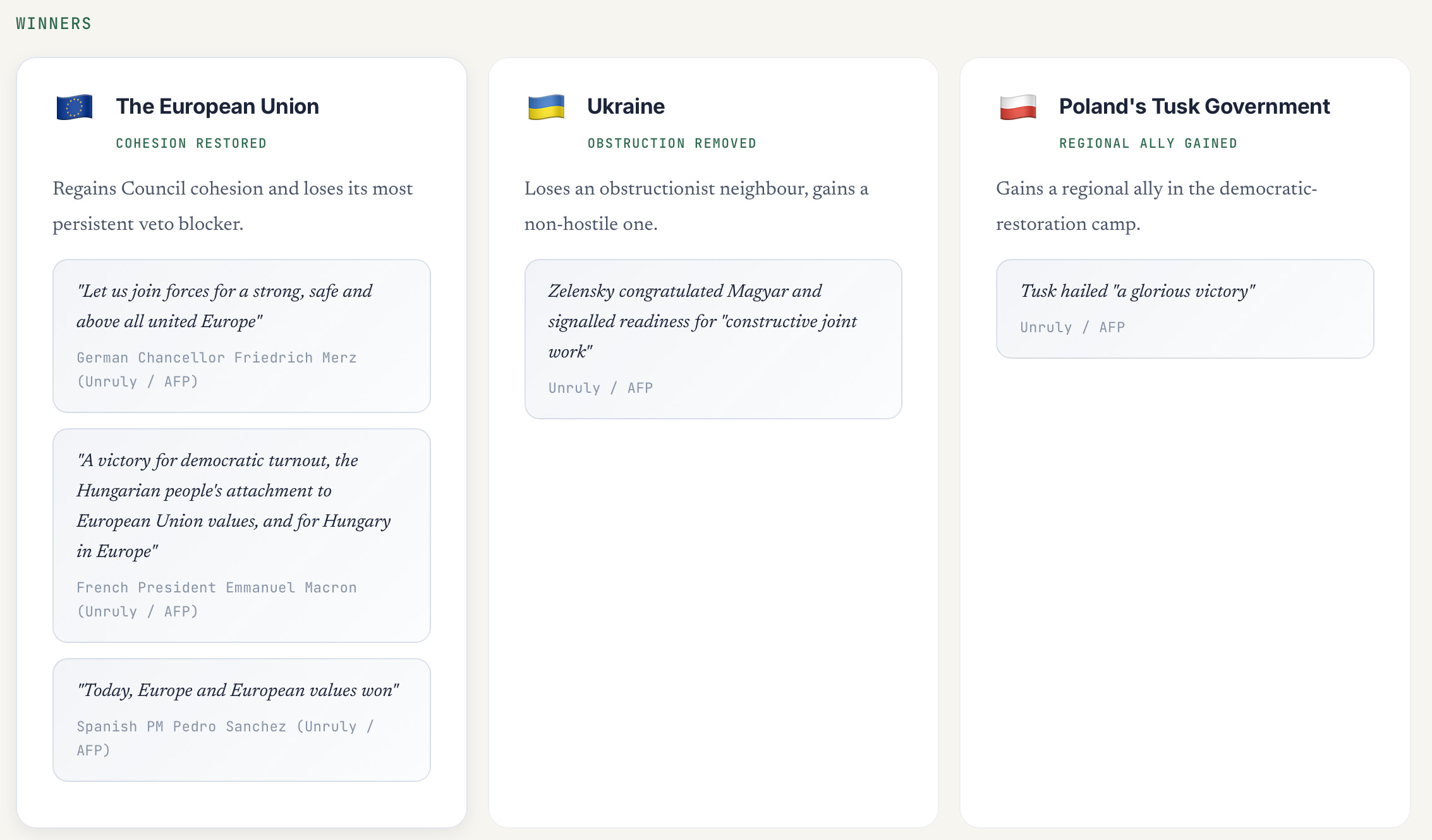
The European Union — regains Council cohesion, loses its most persistent veto blocker. German Chancellor Friedrich Merz wrote: “Let us join forces for a strong, safe and above all united Europe” (Unruly / AFP). French President Emmanuel Macron hailed “a victory for democratic turnout, the Hungarian people’s attachment to European Union values, and for Hungary in Europe” (Unruly / AFP). Spanish PM Pedro Sánchez declared: “Today, Europe and European values won” (Unruly / AFP).
Ukraine — loses an obstructionist neighbour, gains a non-hostile one. Zelensky congratulated Magyar and signalled readiness for “constructive joint work” (Unruly / AFP).
Poland’s Tusk government — gains a regional ally in the democratic-restoration camp. Tusk hailed “a glorious victory” (Unruly / AFP).
Hungarian civil society and independent media — the groups Orbán vowed to crush (”fake civil society organisations, bought journalists, judges and politicians”) gain political space (Unruly / AFP).
UK Prime Minister Keir Starmer — called it “an historic moment, not only for Hungary, but for European democracy” (Unruly / AFP).
Giorgia Meloni — paradoxically, Meloni emerges repositioned. She congratulated Magyar for his “clear election victory” while thanking “my friend Viktor Orbán for the intense collaboration of these last years,” adding she was “certain that we will continue to collaborate constructively” (Unruly / AFP). She is now the undisputed leader of the European right’s illiberal-adjacent wing, without the baggage of Orbán’s defeat.
Losers
Russia — loses its most effective EU disruptor. Evidence of Russian interference in Hungary’s election had been growing throughout the campaign, including reports of a covert Russian social media campaign to boost Orbán (Unruly / AFP), and it failed.
China — loses privileged access and EU veto cover (SCMP).
Trump-world — loses its proof-of-concept and ideological capital. The question of whether the Vance rally helped or hindered Orbán was raised even before the vote (Irish Times).
Fidesz-linked oligarchs — face potential audits, procurement reform, and loss of political protection. Lőrinc Mészáros, Orbán’s childhood friend who became Hungary’s richest man through state contracts (Forbes), is among those most exposed.
Orbán personally — moves from the most powerful figure in Central European politics to opposition leader. He had “transformed his small central European country from a burgeoning Western democracy into an illiberal one” (CNN) — and voters reversed it. Born in 1963, he first became prime minister in 1998 at just 35 — the second youngest in Hungarian history (Wikipedia). He returned to power in 2010 and held it for 16 years.
The “illiberal democracy” brand — the term Orbán used in his infamous 2014 speech at Băile Tușnad, where he declared his government was building an “illiberal state” within the EU (Heinrich Böll Foundation), loses its only successful long-term practitioner inside the EU.
8. The Magyar Question: Can the Insider Deliver System Change?
The biggest risk to the democratic-restoration narrative is Magyar himself. As analyst Andrzej Sadecki of the Warsaw-based Centre for Eastern Studies told AFP: “In a way, Magyar is like Orbán 20 years ago without all the baggage, the corruption and the mistakes made in power” (Unruly / AFP). But that cuts both ways.
Magyar was born on 16 March 1981 (Wikipedia), making him 45 at the time of the election. He was born into a family of prominent conservatives, befriended Orbán’s current chief of staff Gergely Gulyás during university, married Judit Varga in 2006 (she later became Orbán’s justice minister), headed the state’s student loan provider, and sat on the board of multiple state companies (Unruly / AFP). He has even stricter anti-immigration views than Orbán, pledging to end the government’s guest worker programme. His stance on LGBTQ rights is vague, though he emphasises equality before the law. He rejects sending arms to Ukraine and opposes the country’s quick EU integration (Unruly / AFP).
“As he was socialised in Fidesz, there are also doubts whether he can provide a genuine rupture with Orbán’s rule,” Sadecki cautioned. “Left-wing voters might not be fully happy with his agenda, but they still support him, because he represents the biggest chance for change” (Unruly / AFP).
9. Scenarios for the Next 12 Months
Scenario 1: Democratic Restoration Accelerates
Probability: 25%
Magyar secures a confirmed supermajority (133+ seats), moves swiftly to amend cardinal laws, begins judicial and media reform, unfreezes EU funds, and aligns Hungary with mainstream EU positions. Orbán’s institutional traps are dismantled within 12 months.
Triggers: Final seat count confirms supermajority (current projections suggest ~138 seats) (TVP World); EU provides structured support and conditionality framework (EPC); Fidesz fragments in opposition, as loyalist defections accelerate (New York Times).
Scenario 2: Partial Reform, Partial Continuity (Base Case)
Probability: 55%
Magyar governs with a supermajority but faces fierce resistance from Orbán-embedded institutions — the Constitutional Court, the Media Council, the State Audit Office, the presidency. Reform proceeds unevenly: EU funds are partially unfrozen, foreign policy realigns, but media and judicial reform stall. Magyar’s own Fidesz socialisation produces policy continuity on migration and some social issues. The oligarchic networks adapt rather than collapse.
Triggers: Institutional resistance from Orbán loyalists in fixed-term positions (Politico); legal challenges to reform legislation; Magyar’s own conservative instincts limit the scope of change.
Scenario 3: Institutional Sabotage and Backlash
Probability: 20%
Orbán-aligned institutions — particularly the president (in office until 2029), the Constitutional Court, and the State Audit Office — actively obstruct Magyar’s government. Budget vetoes, constitutional challenges, and potential snap-election triggers create governance paralysis. Fidesz regroups around a narrative of illegitimate foreign-backed regime change.
Triggers: President Sulyok blocks key legislation or triggers constitutional crisis (Politico); Constitutional Court strikes down reform laws; economic downturn blamed on new government.
10. Key Judgments and Confidence Levels
Orbán’s defeat is genuine and irreversible as an electoral outcome. He conceded and congratulated the winning party (Unruly / AFP). He will not return to power in this parliamentary term. — High confidence
Tisza will secure a two-thirds supermajority, based on projections of ~138 seats with 90.9% of votes counted (Europe Elects; TVP World). — Moderate-High confidence (final count pending; individual constituency results could shift the total)
The supermajority is necessary but not sufficient for institutional reform. Orbán’s traps — loyalist appointments, the presidency, the Constitutional Court — will slow and complicate reform regardless (Politico). — High confidence
China’s diplomatic leverage in the EU Council is materially reduced. Beijing loses its most reliable veto partner on trade, investment screening, and foreign policy (SCMP). — High confidence
China’s commercial footprint in Hungary will persist in the medium term, even as the regulatory and political environment tightens. CATL’s €7.3bn Debrecen plant (Reuters) and BYD’s ~€4bn Szeged factory (Reuters) represent too much sunk investment to unwind quickly. — Moderate confidence
The Vance rally was a net negative for both Orbán and Trump. It allowed Magyar to frame the election as a choice between Hungarian sovereignty and foreign interference — ironically inverting Orbán’s own playbook (Irish Times). — Moderate confidence
Magyar will align Hungary with mainstream EU foreign policy positions on Russia and Ukraine within 90 days, but will maintain opposition to arms transfers to Ukraine (Unruly / AFP). — Moderate confidence
Media reform will be the hardest institutional domain to address, given the opacity of ownership structures and the legal entrenchment of KESMA, which consolidated over 470 pro-Fidesz outlets (MAPMF; New York Times). RSF has described Orbán as having “nearly wiped out independent journalism” in Hungary (RSF). — High confidence
The Orbán system was designed to survive its creator. As political scientist Gyulai noted, Orbán “managed to build up the political system around himself” so that “all policy issues, ideological preferences, socio-cultural perceptions culminate in one referendum-like question: do you want Viktor Orbán? Yes or no?” (Unruly / AFP). The next 12 months will test whether that design holds against a supermajority and EU pressure. — High confidence
Orbán’s defeat does not signal the death of right-wing populism in Europe. Meloni remains powerful in Italy; the far right made gains (though fell short of key targets) in French municipal elections (Le Monde); and Janša nearly won in Slovenia (Bloomberg). The lesson other populists will draw is operational — avoid visible corruption, maintain service delivery — not ideological. — High confidence
This analysis reflects information available as of 13 April 2026, the day after the Hungarian parliamentary election. Final official results are expected later this week. All seat projections are based on partial counts (90.9% of list votes) and Europe Elects projections.